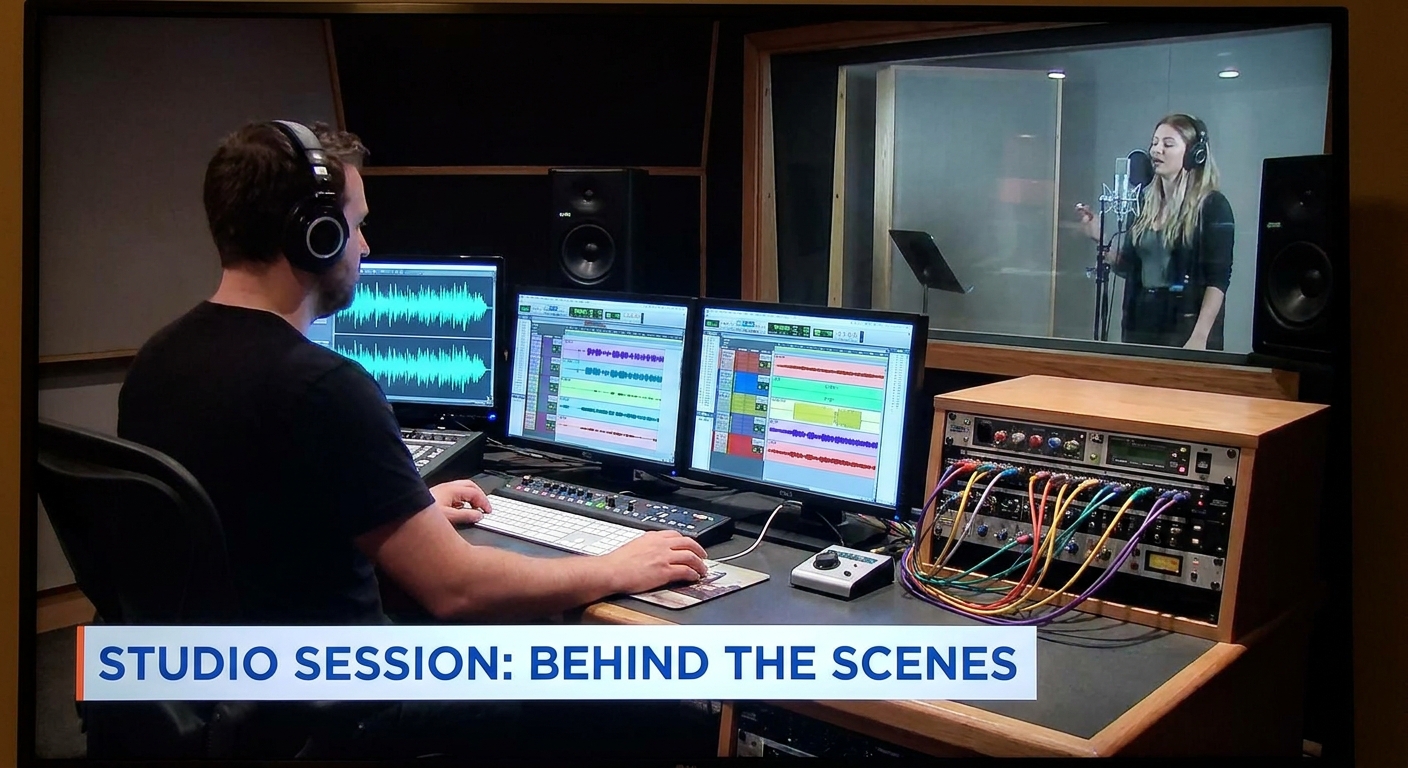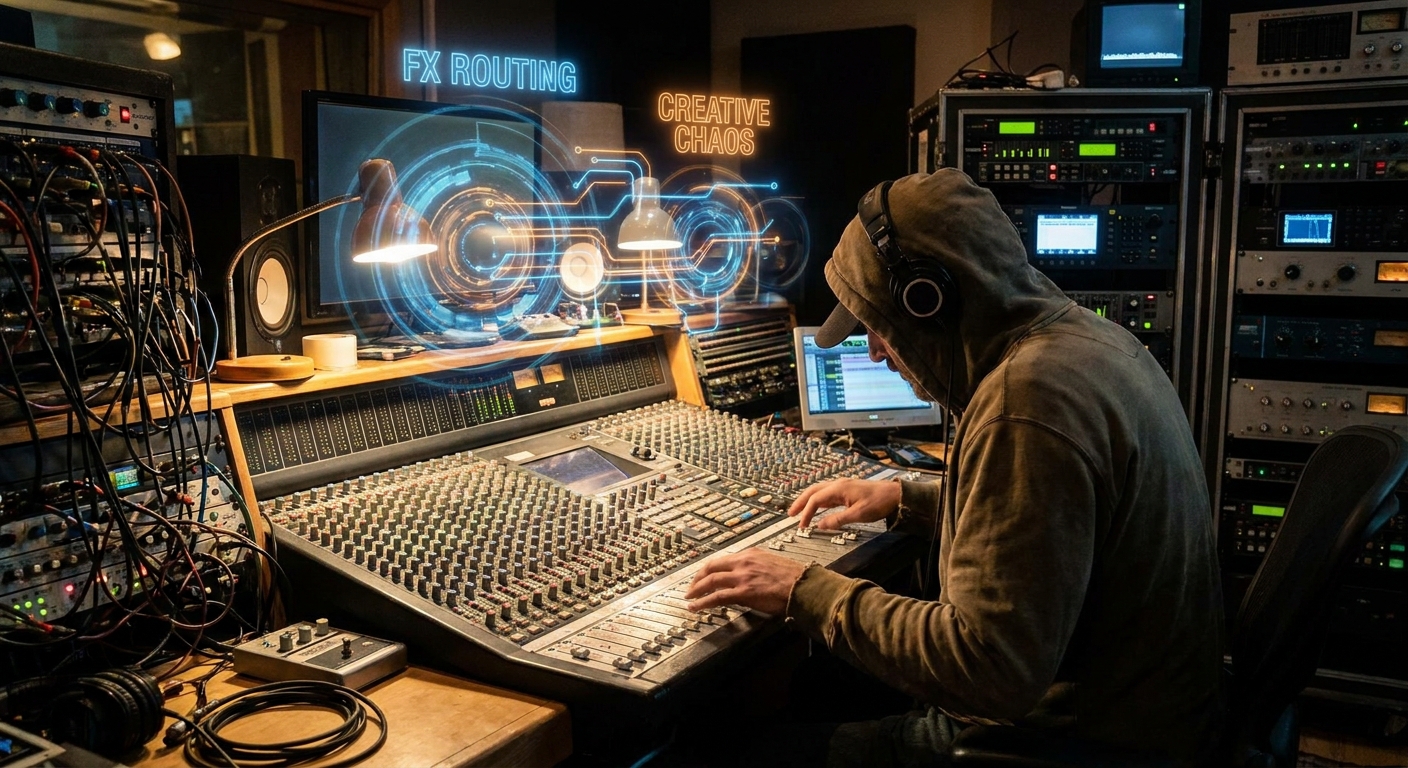
Most producers treat reverb, delay, and modulation as afterthoughts—drop a plugin on a track, pick a preset, move on. But when you treat your FX routing like an instrument, your studio gear becomes a playground for controlled chaos.
Your FX Chain Is a Musical Instrument
We’ll build advanced FX workflows inside popular DAWs that mimic complex hardware rigs: multi-tap delays, feedback loops, and sidechained ambience that moves with the song.
1. Core FX Routing Concepts
Before we get wild, a few fundamentals:
Inserts vs Sends
- Insert FX (on the track itself): Best for corrective tasks or when you want 100% wet (e.g., guitar amp sim)
- Send FX / Aux FX: Best for reverb, delay, chorus—anything shared across multiple tracks
Serial vs Parallel
- Serial: FX placed one after another (EQ → compressor → delay)
- Parallel: Dry signal runs alongside FX chains, then they’re blended
Once you’re comfortable with sends and parallel paths, you can design creative signal flows that go way beyond “Reverb on Aux 1.”
2. Sidechained Reverb That Breathes With the Groove
Classic problem: reverb makes a vocal or lead sound huge, but muddies intelligibility.
The Concept
Put reverb on a send/aux
Route vocal to that send
On the reverb return, insert a compressor
Sidechain the compressor from the dry vocal track
Result: Reverb ducks when the vocal is present, then swells in the gaps.
DAW-Specific Setup
Ableton Live
Create a Return Track: add reverb → compressor
On compressor, enable Sidechain, choose Vocal track
Send Vocal to this return (start around -12 dB)
FL Studio
- Put reverb on a Mixer Insert (e.g., Insert 20)
Route vocal channel to Insert 20 (send only)
Add Fruity Limiter after the reverb, switch to Comp mode
Sidechain: right-click sidechain input selector to pick vocal
Logic Pro
Bus send from vocal to Aux with Space Designer/ChromaVerb
Insert Compressor after reverb
Set Side Chain input (top-right of plugin window) to the vocal
Pro Tools
Create stereo Aux VOC REV, insert reverb → compressor
Send vocal to VOC REV via bus
In compressor sidechain, select that same vocal bus (pre-fader or dedicated send)
Suggested compressor settings:
- Attack: 5–15 ms
- Release: 200–500 ms
- GR: 3–6 dB while vocal is active
3. Feedback Delay Networks: Building Evolving Echo Worlds
Delay becomes powerful when you route FX back into themselves—carefully.
Basic Feedback FX Loop
Create two return tracks: DELAY and VERB
On DELAY: stereo delay (1/4 and 1/8 notes), then EQ
On VERB: long hall or plate
Now, send DELAY into VERB and a little bit of VERB back into DELAY
Result: Echoes feed into reverb, and the reverb tail subtly spawns new echo events.
Important: Keep send levels low to avoid runaway feedback.
DAW Implementation Notes
Ableton Live
- Enable
Sends Onlywhere needed - On Return A (Delay), enable Send to Return B (Verb)
- On Return B, enable small Send to Return A
- Use Mixer Inserts (e.g., 21 = Delay, 22 = Verb)
- Route 21 into 22, and 22 back into 21 at very low levels
- Same concept using aux buses—just watch your routing matrix to avoid master bus feedback
- Automate the cross-sends during build-ups so FX seem to spiral out of control, then pull back before the drop.
FL Studio
Logic Pro / Pro Tools
Creative use:
4. Parallel Distortion and “Ghost Layers”
Distortion on inserts can wreck dynamics. Parallel paths keep punch while adding aggression.
The Ghost Layer Technique
Duplicate a key element (lead vocal, main synth, bass)
On the duplicate:
- Add distortion or amp sim - Tight compression (slow attack, fast release) - Heavy HPF at 150–250 Hz and LPF at 6–8 kHz
Blend low under original
Result: Perceived loudness and attitude without losing clarity.
Bonus: Rhythmic Gating
Add a noise gate or volume shaper after distortion on the ghost layer:
- Sidechain-triggered from the kick or snare for a pumping feel
- Or driven by MIDI (in tools like ShaperBox, LFO Tool, or stock tremolo)
This turns a static distortion layer into a rhythmic FX instrument.
5. Multi-Band FX: Frequency-Selective Madness
Instead of one big FX send, split processing into frequency ranges.
Conceptual Flow
Source → Split into 3 bands (Low / Mid / High) → Different FX per band → Recombine
You can do this with:
- Dedicated multi-band plugins (FabFilter Saturn, iZotope Trash, OTT-style tools)
- Manual routing and crossovers
Manual Multi-Band Routing (Any DAW)
Duplicate track into three copies: LOW, MID, HIGH
On each, use EQ as crossover:
- LOW: LPF at ~200 Hz - MID: HPF 200 Hz, LPF 4 kHz - HIGH: HPF 4 kHz
Apply different FX:
- LOW: gentle saturation, mono-ize - MID: chorus, phaser, medium compression - HIGH: delay + reverb, maybe stereo widening
Group them and process the group like one instrument
This works wonders on pads, vocal chops, and melodic bass.
6. Performance-Based FX Control: Turning Knobs Like a Player
Hardware has an edge because you touch it. You can recreate that with MIDI and automation.
Macro Mapping
Ableton Live
- Use Instrument/Effect Racks
- Map multiple parameters (reverb send, delay feedback, filter cutoff) to one Macro
- MIDI-map that Macro to a knob or fader
- Use Controller Links: right-click parameter → Link to controller
- Or build complex routings inside Patcher and map macros
- Use Smart Controls to tie multiple plugin parameters to one knob
- Use Automation Lanes and a control surface (or MIDI controller mapped via EuCon/HUI)
FL Studio
Logic Pro
Pro Tools
Practical Performance Ideas
- “Drop FX” macro that:
- Cuts low-end
- Increases reverb send
- Raises delay feedback
- Lowers overall level slightly
- “Build Macro” that automates:
- Filter cutoff upwards
- Saturation drive up +1–2 dB
- Width expansion on a bus
Record these macro moves in real time while listening like a musician, not a programmer.
7. Resampling and Re-Editing Your FX
One underused technique: printing FX to audio and then mangling that audio.
Workflow (any DAW):
Solo your FX returns (or use separate record-enabled tracks receiving from them)
Record a pass of just the FX
Now treat that recording as a new sound source:
- Reverse it - Chop rhythmic slices - Time-stretch or granulate it
This works especially well for:
- Atmospheric intros/outros
- Transitions and risers using your own sonic DNA
- Unique one-shot stabs built from your own reverb tails
8. Safety and Sanity: Keeping Creative Chaos Under Control
When pushing FX routing hard:
- Gain-stage relentlessly—avoid digital clipping in feedback loops
- Use limiters on FX buses as safety nets
- Color-code complex routings and name tracks clearly (
FX DEL A,FX RVB LONG) - Save these setups as templates or channel strip presets for future tracks
Final Thoughts
Your studio gear—physical and virtual—can do far more than polite ambience. By:
- Treating sends and buses like modular patch points
- Using sidechains and feedback safely
- Performing FX parameters like an instrument
…you turn your DAW into a living, breathing FX rig.
Start with one trick: sidechained reverb, a feedback delay loop, or a ghost distortion layer. Bake it into a template, then build from there. Over time, your FX routing becomes a signature sound no preset pack can touch.